Volterra's Cliffs

Maya
| 03-09-2026
 · Travel team
Hello, friends. You might think of Volterra as the walled hilltop town with Etruscan gates and alabaster shops, and you wouldn't be wrong.
But step to the edge of town, look past the medieval ramparts, and you'll find something far wilder: Le Balze.
These are the deep, sculpted ravines of clay and sand that look like a giant took a cutter to the hillside, and they're every bit as impressive as the town itself.
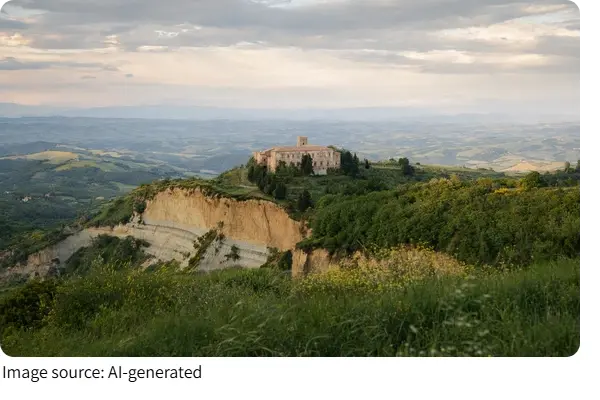
The landscape that time forgot
Le Balze isn't a single viewpoint, it's a whole geological zone stretching along the western edge of the Volterra plateau. Erosion has been carving this land for centuries, and the result is a maze of jagged spires, steep gullies, and crumbling terraces in shades of gray, yellow, and rust.
Because the clay is so soft, the scenery actually changes year to year, with new towers forming and old ones collapsing. It's a landscape that feels ancient and alive at the same time, and it's the reason the town's edge looks like the end of the world in a good way.
Why the quick birth matters
The best part is you don't need a hike to see it. You can stand right at the Belvedere, a terrace near the Porta Fiorentina gate, and get a sweeping view of the badlands below. From there, the ravine drops away in a series of dramatic steps, with the town's old walls clinging to the very lip of the cliff.
If you want to get closer, there's a short walking path that descends into the valley, but it's steep and can be slippery after rain, so wear proper shoes. The contrast is striking: on one side, a neat Renaissance piazza, on the other, a raw, sculpted desert.
Le Balze
A walk through the erosion
For a deeper look, follow the path that leads down toward the Badia monastery ruins. It's a quiet walk, mostly downhill, and you'll pass right alongside the strange clay pillars that locals call "the giants." These formations are the result of centuries of wind and water stripping away the softer material, leaving harder caps on top.
You'll also spot where the ground has cracked and slid, which makes you appreciate how fragile the whole plateau really is. The trail isn't long, maybe an hour round trip, but it gives you a sense of the scale you just can't get from the top.
Plan your visit
Getting there is easy. Volterra is about an hour's drive from Pisa or Siena, and there's a public bus from the train station at Saline di Volterra if you're coming by rail. The Belvedere itself is free, and parking near Porta Fiorentina costs around 1.50 USD per hour.
The best light is late afternoon, when the low sun turns the clay a deep orange, but mornings are less crowded. Just don't try to climb down the steep slopes for a photo, people have slipped, and the rescue is not a fun story.
Budget and timing
A full visit to Volterra and Le Balze can easily take half a day if you wander the town, too. Entry to the main sights like the Etruscan Museum runs about 10 USD, but the Balze itself costs nothing. If you're on a tight schedule, give it at least two hours, one for the viewpoints and a short walk, and one to soak in the town's atmosphere. The cliffs are worth seeing in any season, but spring and fall have the clearest skies and the most comfortable temperatures.
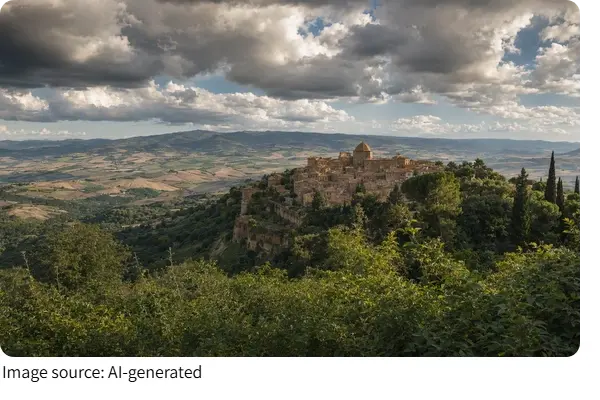
So next time you're in Tuscany and someone tells you to stick to Florence and San Gimignano, remember this: the real drama is often on the edge of the map. Stand at the Belvedere, watch the light hit those clay spires, and you'll understand why this spot stuck with you long after you leave.