Assisi From Above

Celia
| 02-09-2026
 · Travel team
Assisi is best understood as a hillside city rather than a collection of isolated monuments.
Its pale stone buildings climb the lower slopes of Mount Subasio, while the Basilica of Saint Francis anchors the western edge above the Umbrian plain.
The historic center and its Franciscan sites have UNESCO World Heritage status, but the experience improves markedly when you plan around elevation. Start high, walk gradually downhill through the old center, and save one elevated viewpoint for late afternoon.
Walk Assisi Downhill
Most first-time visitors enter Assisi near the lower western side and then repeatedly climb toward the upper town. A more comfortable route reverses that logic.
Start at the upper edge
Piazza Matteotti is one of the most useful starting points because it sits near the upper part of the historic center and close to Rocca Maggiore. If you arrive by train, Assisi station is below the hill near Santa Maria degli Angeli, and bus line C connects the station with the historic center.
Give the central walking route about five hours, including interiors and a proper lunch. From Piazza Matteotti, descend toward Piazza del Comune rather than rushing directly to the Basilica. Assisi rewards slow walking because its streets frequently open onto small views across rooftops and the Umbrian plain.
Continue west through the center and finish at the Basilica of Saint Francis. Admission is free. The Upper Basilica generally opens from 08:30, while the Lower Basilica opens earlier; seasonal closing hours differ, so it is worth checking the official schedule before the visit.
This sequence also solves a practical problem. The Basilica sits near the lower western side of the old town, so ending there prevents a long uphill return through the entire center. If your accommodation is higher up, use local transport afterward rather than automatically retracing every street on foot.
Leave room for the streets themselves
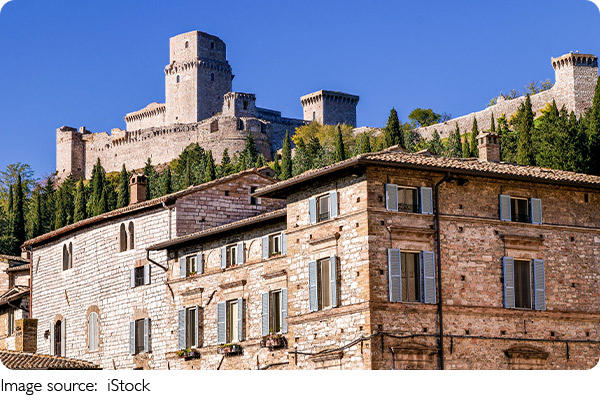
Do not allocate the whole day to interiors. Assisi architecture is unusually coherent because pale local stone appears across defensive walls, civic buildings, arcades, houses, and large complexes. The long façade and arcaded structure visible from outside the city are part of that larger visual identity.
Piazza del Comune deserves at least 30 minutes. The square preserves traces of Roman and medieval Assisi, including the Temple of Minerva and civic buildings. The official tourism office also maps a full Roman Assisi itinerary through the upper town and center, confirming how much older material survives beneath the medieval streets.
For a one-day architectural route, however, resist adding every museum. The city is compact but steep, and excessive indoor stops make the day feel more fragmented than informative.
See the City as a Landscape
Assisi becomes more interesting once you stop viewing it only from street level. From above, the dense stone center, defensive walls, Basilica complex, cultivated slopes, and broad plain finally fit together.
Climb once, to Rocca Maggiore
Save Rocca Maggiore for your second afternoon. The fortress stands around 500 metres above sea level on the hill above Assisi and is approximately 550 metres from Piazza Matteotti. The walk is short in distance but consistently uphill, so allow around 20 to 30 minutes rather than judging it by the map alone.
A standard ticket costs EUR 8, while a EUR 10 combined ticket also includes the Roman Forum and Municipal Art Gallery, with an audio guide. Choose the combined option only if those sites genuinely fit your plan. Paying more for attractions you rush through adds little value.
Spend roughly 90 minutes around the fortress and viewpoints. The elevation explains the geography of Assisi far better than street-level wandering alone. You can see how tightly the historic center occupies the slope, while farmland spreads across the plain below.
Aim for the final two hours before sunset when possible. Lower light creates stronger separation between stone buildings, green slopes, and distant fields. If clouds are moving across the valley, wait rather than leaving immediately; changing light can transform the entire view within minutes.
Stay inside or beside the walls
Two nights are enough for a focused Assisi stay. Choose accommodation either within the historic center or immediately outside one of the main gates. Sleeping far down on the plain may reduce room costs, but it adds a hill transfer every morning and evening.
Comfortable central rooms generally fall around EUR 100–170 per night, depending on season and booking date. For two people sharing, around EUR 220–320 per person is a sensible two-night planning range for accommodation, meals, local transport, and basic sightseeing, excluding travel to Assisi.
A car is unnecessary once you arrive. In fact, only authorized vehicles may enter the historic center, and the city directs visitors toward parking areas outside the restricted zone. If you are arriving by rail, the station-to-center bus is usually simpler than renting a vehicle solely for Assisi.
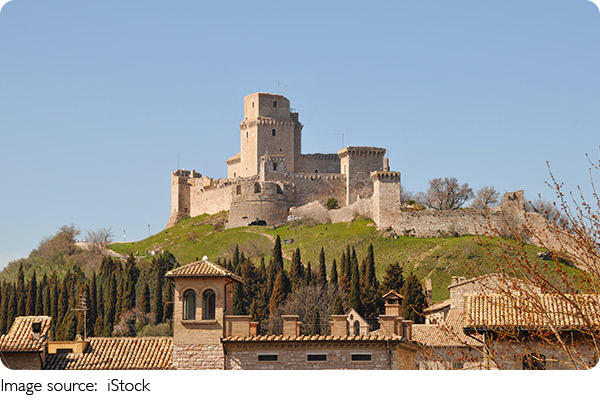
Assisi is most satisfying when you let its slope organize the visit. Walk from the upper town toward the Basilica on the first day, then return to the heights for the broad view from Rocca Maggiore. That simple change in direction turns the city from a maze of steep streets into something much easier to read: a compact stone settlement layered across a green Umbrian hillside, with architecture and landscape designed to be seen together.