Between Walls and Sea

Caroll Alvarado
| 02-09-2026
 · Travel team
Peñíscola rises from the Mediterranean on a rocky headland in Castellón, with its old town compressed inside fortified walls and its castle occupying the highest point.
The unusual geography is the reason to come: within a relatively small area, you can move from a broad sandy shoreline to narrow whitewashed streets and then climb above the rooftops for open sea views.
Peñíscola
Circle the Headland First
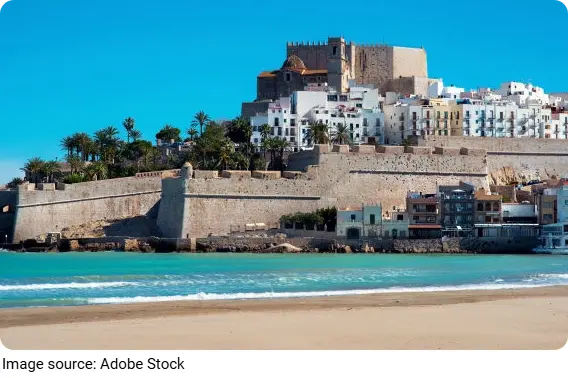
Resist heading directly uphill when you arrive. Peñíscola makes far more sense after seeing its fortified silhouette from below, where the relationship between beach, walls, houses, and castle is immediately clear.
Begin on Playa Norte
Start from Playa Norte and walk south toward the old town. The beach extends for several kilometres north of the historic center, so you do not need to cover its entire length. A 20 to 30 minute approach is enough to watch the headland gradually fill your view.
From this side, the town appears almost stacked vertically: sea and sand at the bottom, defensive walls above them, dense white buildings on the slope, and the castle at the summit. It is one of the few places where the basic layout of a medieval coastal town can be understood before you enter it.
Once you reach the walls, continue around the lower edge of the headland rather than immediately climbing. Allow roughly 90 minutes for this first circuit, including stops. You will encounter changing sea views and several entrances into the historic center, making it easier to decide where to begin the ascent.
Morning works particularly well for this section. If you start around 09:00, temperatures are usually more comfortable than in the middle of a summer day and the old center has not yet reached its busiest period.
May, June, September, and early October offer a useful balance for travelers who want both walking and time beside the Mediterranean. July and August provide classic beach weather but bring much heavier visitor numbers and hotter midday conditions.
Climb slowly through the old town
Peñíscola old town is compact enough that distances can be misleading. The castle may be only several hundred metres away horizontally, but steep lanes, stairs, viewpoints, and frequent stops make the climb considerably slower.
Give yourself around two hours between entering the historic center and reaching the castle. Wander through the whitewashed streets instead of selecting the shortest route on a map. Balconies, stone passages, blue details, and sudden openings toward the Mediterranean are part of the experience.
One worthwhile stop is Casa de les Petxines, a distinctive facade covered with shells near the upper old town. Continue from there toward the castle rather than descending again.
Comfortable shoes matter here. Smooth stone surfaces and steps appear throughout the historic center, and the route becomes less forgiving after rain. You do not need hiking equipment, but beach footwear is a poor choice for several hours of climbing and descending.
Save the Castle for Later
The castle is the towns visual anchor, but visiting it at the beginning removes the sense of progression. Reach it after you have already seen Peñíscola from sea level and walked through the streets beneath it.
Allow two hours at the summit
Peñíscola Castle was constructed by the Knights Templar between 1294 and 1307 on the remains of an earlier fortress. Its elevated position provides views across both sides of the headland and far along the coastline.
General admission is EUR 5, with reduced EUR 3.50 admission for eligible visitors. The ticket also includes access to the Artillery Park gardens. Allow around 90 minutes for the castle itself and another 30 minutes for the adjoining outdoor areas rather than treating the interior as a quick route to the viewpoints.
The walls and terraces are particularly useful for understanding the town you have just crossed. Playa Norte stretches away on one side, while the Mediterranean surrounds much of the remaining headland. Dense rooftops occupy almost every available space between the castle and fortifications.
Check closing time before choosing a late visit because opening hours change seasonally. If the schedule allows, late afternoon is preferable to midday: lower sunlight brings more texture to the stone walls and reduces the harshest heat.
Sleep close enough to return after dinner
The strongest argument for staying overnight appears after the main sightseeing period ends. Instead of immediately leaving after the castle, descend for dinner and return to the old streets later in the evening.
Look for accommodation within roughly a 10 to 15 minute walk of the historic center. Staying directly inside the walls has atmosphere, but luggage and steep pedestrian lanes can make arrival less convenient. A property just outside the old town often provides the better compromise.
Comfortable double rooms commonly require around EUR 80–150 per night, depending on season and booking date. Two people sharing can plan approximately EUR 180–280 per person for two nights, meals, castle admission, and ordinary local expenses, excluding transport to Peñíscola.
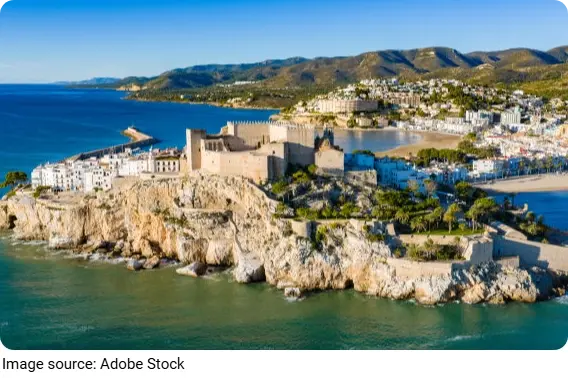
That sequence is what makes Peñíscola worth more than a brief castle stop. Spend the first day moving from shoreline to summit, stay after the crowds thin, and return to sea level the next morning. In barely two days, the same rocky headland presents itself as a beach destination, fortified old town, elevated viewpoint, and Mediterranean landscape without requiring a long list of disconnected attractions.