Storage Meets Beauty

Camille Dubois
| 02-07-2026
 · Lifestyle team
The usual tension in home organization is between function and appearance — storage that works tends to look utilitarian, and storage that looks good often doesn't work well enough to actually use.
The good news is that this is a false trade-off. With the right approach, the things you use to store and organize can actively improve how your home looks rather than being something you hide from guests.
Double-Duty Furniture First
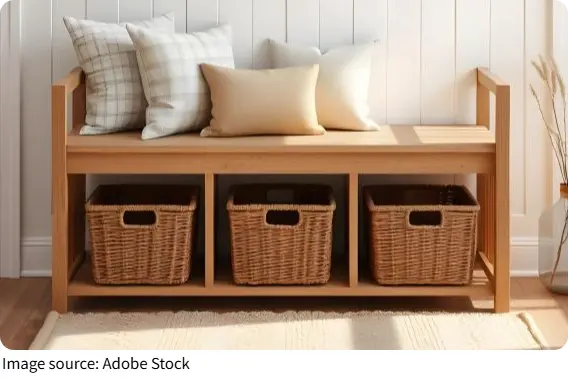
The most space-efficient and visually elegant storage strategy starts with furniture that does two things at once. A storage bench in the living room holds extra blankets and remotes while functioning as a footrest or extra seating. A bench at the foot of the bed or in an entryway conceals shoes and linens while providing somewhere to sit.
A lift-top coffee table hides books and games in a compartment that opens from the top. A vintage trunk used as a coffee table can hold anything from throws to seasonal items while looking like a deliberate design choice.
When furniture works this hard, clutter disappears without requiring any separate storage pieces at all. The room looks considered rather than stuffed, because the organization is built into the room itself rather than layered on top of it.
Baskets and Boxes as Decor
Not everything needs to be hidden. Some of the most effective storage-as-decor involves using containers that are attractive enough that their presence adds to the room rather than distracting from it.
Large woven seagrass or water hyacinth baskets in a living room corner can hold throw pillows, toys, or anything else that needs corralling — and they look warm and intentional sitting there, not makeshift. Fabric-covered storage boxes stacked on a bookshelf hold paperwork or cables while reading as a deliberate design element.
The principle is to choose containers that match the room's aesthetic: rustic wicker or natural fiber for warmer, earthier spaces; sleek monochrome boxes or clear acrylic bins for modern, minimal rooms. When the container suits the room, the storage becomes part of the decor. When it doesn't, it just reads as a mess with a lid on it.
Go Vertical with Floating Shelves
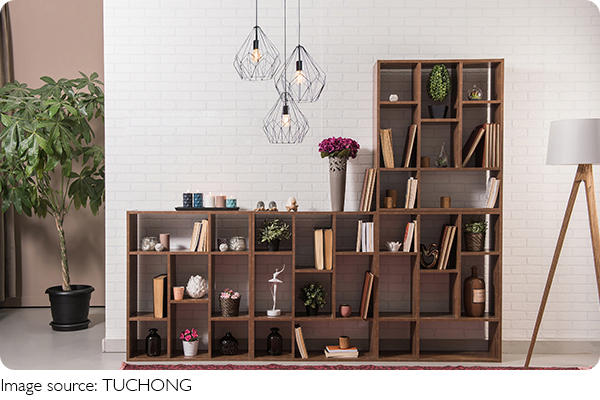
Walls are storage. Most people underuse them entirely. A row of floating shelves can hold books, plants, framed photos, small baskets, and decorative objects simultaneously — providing real storage while creating a display that draws the eye upward and makes the room feel larger. Shelves work in every room: in the living room for books and decor, in the kitchen for jars and cookbooks, in the bathroom over the toilet for towels and toiletries.
The key to shelves that look styled rather than cluttered is the same as any display: group things in odd numbers, vary heights within each grouping, and leave some deliberate negative space between groups. The negative space is not empty — it's what makes the display feel considered rather than overloaded.
The 60/40 Rule
A useful guideline for any surface with both stored and displayed items is 60% functional storage to 40% display. This ratio keeps things practical without letting the organizational elements overwhelm the aesthetic.
On a bookshelf, that might mean two-thirds filled with actual books, one-third occupied by a plant, a framed photo, and a small object. On a sideboard, it means the doors hold useful items, and the top holds a lamp, a vase, and one or two objects that are worth looking at.
The Five-Minute Evening Reset
The most stylish storage system fails if things don't get returned to their places. The practical habit that makes everything else work is a five-minute walk-through before bed — returning items to where they belong, clearing surfaces, doing the one-minute tasks that prevent small accumulations from becoming overwhelming.
A home that gets five minutes of attention every evening stays genuinely organized far more reliably than one that gets an ambitious overhaul once a month.