Kiama Night

Elena Rossi
| 29-04-2026
 · Travel team
The stars do not rise and set the way most people picture them. From a fixed position on Earth over several hours, they trace perfect arcs across the sky, each one a curved line of light bending around the celestial pole.
A long-exposure photograph captures those arcs simultaneously, producing the circular sweep of white lines visible above the Kiama Lighthouse, with the white tower standing steady at the center while the entire sky rotates around it.
This is astrophotography at its most compelling, and Kiama on the New South Wales south coast is one of the best locations in Australia to attempt it.
Kiama is a coastal town of approximately 23,000 residents located 120 kilometers south of Sydney, known for its dramatic blowhole, historic lighthouse precinct, and consistent dark sky conditions on clear nights. The lighthouse sits on Blowhole Point, a basalt headland that juts into the Tasman Sea, providing 360-degree horizon visibility that makes it one of the most accessible and photogenic night sky locations on the NSW coast.
Getting There
Kiama is one of the most accessible coastal day trips and overnight destinations from Sydney, served by direct trains from Sydney's Central Station throughout the day. The journey takes approximately one hour and forty-five minutes on the South Coast Line, with tickets costing approximately $6 to $8 per person each way using an Opal card or approximately $10 to $14 for a paper ticket.
From Sydney Airport, the train journey via Central Station takes approximately two hours total. A car is not necessary for visiting the lighthouse precinct and blowhole, as both are within easy walking distance of Kiama train station at approximately 10 minutes on foot.
For visitors wanting to explore the broader south coast, car rental from Sydney starts from approximately $45 to $70 per day, with the drive to Kiama taking approximately one hour and forty minutes via the M1 motorway south.
Kiama Lighthouse
The Lighthouse and Blowhole Precinct
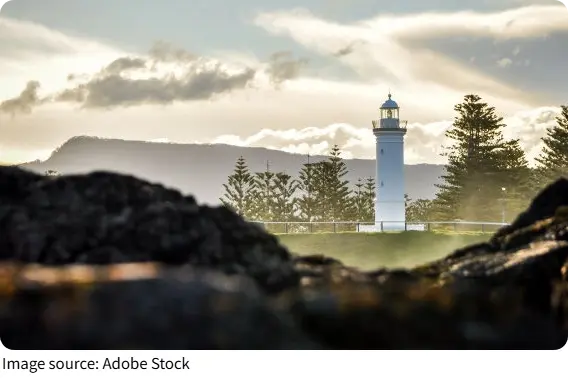
The Kiama Lighthouse was constructed in 1887 from local basalt and is one of the oldest operating lighthouses on the New South Wales coast. It stands approximately 15 meters tall on the Blowhole Point headland and is still an active navigational aid, managed by the NSW Roads and Maritime Services.
The lighthouse precinct is freely accessible at all hours, with the surrounding park and coastal walking paths open to the public continuously. The lighthouse exterior and the headland provide the primary viewing positions for both daytime coastal scenery and nighttime star photography.
The Great Kiama Blowhole, located directly adjacent to the lighthouse on the same basalt headland, is one of the largest blowholes in the world. When ocean swells push water through a sea cave beneath the headland, a jet of water and spray erupts through a natural opening in the rock, sometimes reaching heights of over 20 meters. The blowhole is most active during strong southerly swells and is freely viewable from the surrounding paths at all hours.
Key Experiences and Costs
Kiama's main experiences concentrate on the lighthouse precinct, the coastal walks, and the night sky photography opportunities that the headland's dark horizon provides.
1. Blowhole Point coastal walk, a short loop of approximately 1.5 kilometers around the headland passing the blowhole, lighthouse, and rock platform, takes approximately 30 minutes and is freely accessible at all hours. The rock platforms on the eastern side of the headland are excellent for watching ocean swells and seabird activity.
2. Kiama Coast Walk, a longer trail of approximately 22 kilometers running from Kiama south to Gerroa, passes through coastal heathland, clifftop sections, and several small beaches. Sections of any length can be walked independently. No entry fee.
3. Night sky photography from Blowhole Point requires arriving after 9 p.m. on a clear moonless night and setting up a camera on a tripod facing south. The southern celestial pole sits above the horizon at this latitude, and exposures of 30 minutes or longer produce the star trail arcs visible in the scene above. No permit required for photography on the public headland.
4. Kiama Harbour and town center, a 10-minute walk from the lighthouse, contains a covered fish market open on weekend mornings and a concentration of cafes and restaurants serving fresh local seafood.
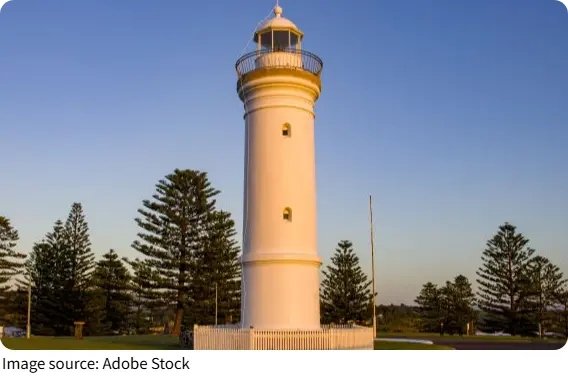
Kiama rewards visitors who stay overnight rather than treating it as a day trip. The lighthouse at dawn, when the sun rises directly over the Tasman Sea and the basalt headland catches the first warm light, and the same headland after dark on a clear night, when the star trails begin to accumulate above the white tower, are two completely different experiences of the same place. Both are worth having. Neither requires anything beyond arriving and staying long enough for the sky to do its work.