Wdzydze Lake

Marcus
| 29-04-2026
 · Travel team
Somewhere in northern Poland, tucked inside a landscape shaped by ancient glaciers, there's a lake that locals call "the Kashubian Sea." Its deep, sapphire waters stretch toward the horizon, carving a path through endless forests that feel as ancient and untouched as the ice that first created them.
That nickname isn't just poetic — Wdzydze Lake is genuinely vast, stretching across 1,455 hectares, dropping to 72 meters at its deepest point, and dotted with seven natural islands that rise quietly from the water like green hills that forgot to stop growing.
Most international travelers have never heard of it. That's both the shame and the appeal. It remains a quiet sanctuary where the footprints of mass tourism haven't yet blurred the edges of its wild, natural charm.
What Makes Wdzydze So Special
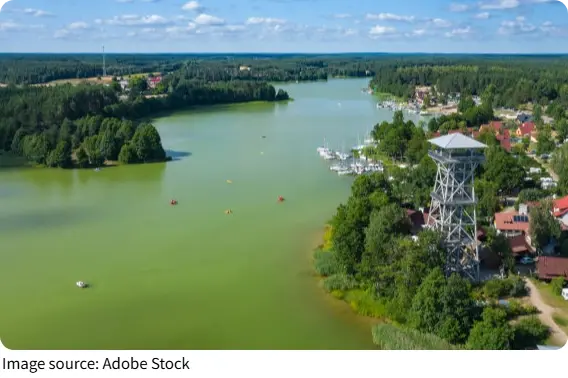
The lake is actually part of a cross-shaped system of four interconnected lakes — Wdzydze, Radolne, Gołuń, and Jelenie — that stretch 9 to 12 kilometers in two directions. From the observation tower in the village of Wdzydze Kiszewskie, you can see the entire cross laid out below you, surrounded by dense Tuchola Forest. It's one of those views that makes you stop mid-sentence. The forest runs right to the water's edge, rising 7 to 10 meters above the surface in some places, and the islands scattered across the main lake are home to rare water birds, protected plant species, and absolute quiet.
There's also an endemic species of lake trout found nowhere else on earth — the wdzydzka trout — which has lived in these waters long enough to adapt entirely to freshwater life, never migrating to the sea the way its relatives do. That alone makes this place unusual.
Getting There
The nearest major airport is Gdańsk Airport, about 75 kilometers from Wdzydze Kiszewskie. From Gdańsk, you can reach the area by regional bus or train to Kościerzyna, and then by local transport to the lake villages — but honestly, a rental car makes the whole trip significantly easier and more flexible. Rental rates from Gdańsk run around $40 to $70 per day for a standard vehicle. The drive through the Kashubian countryside is genuinely pleasant, with rolling hills and pine forests the whole way.
What to Do on the Lake
Kayaking and canoeing are the heart of the experience here. The lake's calm arms and the connected Wda River offer one of the best paddling routes in the region — you can rent a canoe near Wdzydze Kiszewskie for around $10 to $15 per hour and spend a half-day drifting between the islands. The islands themselves are protected habitat, so you don't land on them, but paddling around Ostrów Wielki — the second largest lake island in all of Poland, stretching 3 kilometers long — while herons circle overhead is its own kind of reward.
For those who prefer dry ground, the Wdzydze Landscape Park has 185 kilometers of marked hiking and cycling trails threading through the surrounding forest. The 46-kilometer loop around the lake makes for a solid full-day bike ride with multiple viewpoints, old wooden villages, and the kind of rural scenery that feels entirely unhurried.
Wdzydze Lake
Don't skip the Kashubian Ethnographic Park right in Wdzydze Kiszewskie — it's the oldest open-air museum in Poland, with traditional cottages, windmills, manor houses, and chapels preserved exactly as they stood centuries ago. Entrance costs around $5 per person.
Where to Stay
Accommodation around the lake leans toward agriotourism guesthouses and lakeside cottages rather than hotels, which is part of the charm. Weranda Apartment in Wdzydze Kiszewskie sits within walking distance of the observation tower and close to the lake, with rooms starting around $50 to $70 per night. For a more immersive experience, the village of Gołuń offers camping sites and agritourism stays starting from $25 to $40 per night—offering basic, clean accommodations positioned right at the water's edge.
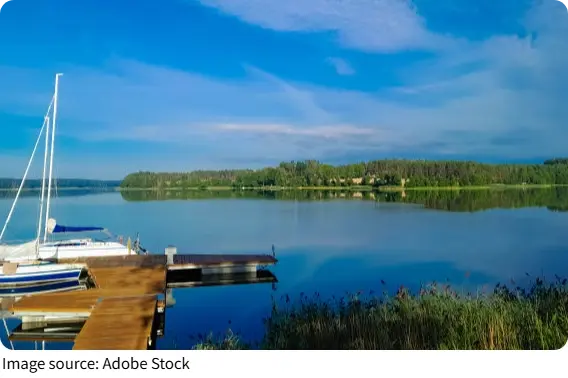
Wdzydze is the kind of place that rewards the unhurried traveler. Come for the kayaking, stay for the silence, and leave wondering why this corner of the world remained a secret for so long. It is a landscape that proves true beauty doesn't need a crowd to be significant; here, the vastness of the water and the ancient depth of the forest offer a rare, grounding sense of perspective. In a world that never stops moving, Wdzydze is a masterclass in the art of standing still—a perfect sanctuary for those looking to reconnect with the quiet pulse of nature.