Japan's Most Magical Lake

Rafael
| 09-05-2026
 · Travel team
A Lake Born From Fire
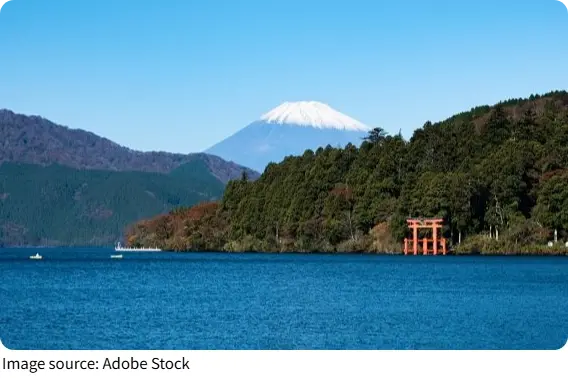
Over 3,000 years ago, Mount Hakone erupted for the last time and left behind one of Japan's most breathtaking gifts — a deep caldera lake cradled by forested mountains, with the snow-capped silhouette of Mount Fuji hovering on the horizon.
Lake Ashi, known in Japanese as Ashinoko, is not just scenic — it is mythological. A 1,200-year-old Shinto shrine sits on its southern shore, its famous vermillion torii gate rising straight out of the water, framing Fuji on clear days in a composition so perfect it seems staged. Visibility is best in winter mornings, when the cold air strips the atmosphere clean and the mountain appears in razor-sharp detail above the still, dark water.
What To Do Around the Lake
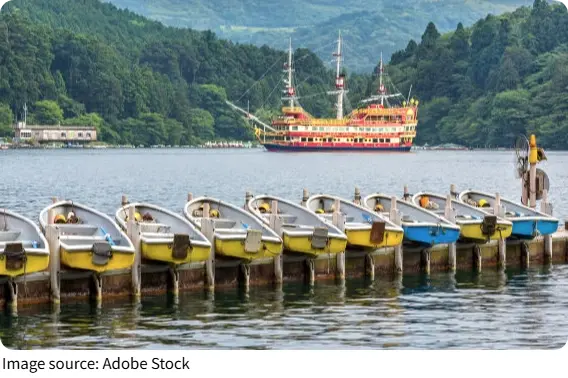
The most iconic way to experience Lake Ashi is aboard the Hakone Sightseeing Cruise — a fleet of three ships modeled after 17th-century European sailing vessels, painted in vivid colors and nicknamed the "Pirate Ships." A single crossing between Togendai Port and Moto-Hakone Port takes around 25 minutes and delivers unobstructed views of the lake, the surrounding cedar forests, and on lucky days, Mount Fuji herself.
The lake shoreline also preserves a remarkable stretch of the ancient Tokaido Road — the historic highway that once connected Kyoto to Tokyo — lined with 300-year-old towering cedar trees that shade the path in cathedral-like silence. Walking this road beside the water, with no cars and no noise, is one of Hakone's most quietly extraordinary experiences.
Hot Springs, Shrines, and Open-Air Art
Hakone Shrine, just steps from the lake's southern shore, has drawn pilgrims for over a millennium. Its deep forested approach, stone lanterns, and lakeside torii make it one of the most atmospheric Shinto sites in the entire Kanto region — and entry is completely free.
A short distance away, the Hakone Open-Air Museum blends sculpture with landscape across a sprawling hillside garden, featuring works by both Japanese and international artists displayed against mountain backdrops. After a full day on foot, the area's hot spring baths — fed by geothermal water from the still-active volcanic zone — are waiting in virtually every hotel and ryokan in the region.
Lake Ashi
Practical Visitor Information
• Getting There: From Tokyo's Shinjuku Station, take the Odakyu Romance Car limited express directly to Hakone-Yumoto Station — approximately 85 minutes. From there, the Hakone Tozan Bus reaches Moto-Hakone in 35 minutes.
• Best Value Pass: The Hakone Free Pass covers unlimited use of all local transport including the pirate ship cruise, ropeway, and cable car. A 2-day pass from Shinjuku costs approximately $41 per person; a 3-day pass is $44.
• Lake Entry: Free. The lakeshore and Hakone Shrine are open to all visitors at no charge.
• Pirate Ship Cruise (without Free Pass): approximately $12 one-way per person.
Accommodation:
1. Budget guesthouses and hostels in Hakone-Yumoto: $40–$70 per night.
2. Mid-range hotels with hot spring baths: $100–$180 per night.
3. Traditional ryokan with full kaiseki dinner and breakfast: $200–$400 per person per night.
Tokyo's Greatest Day Trip
Lake Ashi rewards every kind of traveler — the history seeker walking ancient roads, the photographer chasing Fuji at dawn, the exhausted city visitor who simply wants to lower themselves into a steaming outdoor bath and stare at the mountains. It is 90 minutes from one of the world's busiest cities, yet feels like another world entirely. Come early, stay late, and let the lake do what it has been doing for 3,000 years — quietly stealing hearts.