Earth's Living Canvas

Lucas Schneider
| 29-04-2026
 · Travel team
A Landscape That Defies Logic
Step onto the boardwalks of Mammoth Hot Springs in Yellowstone National Park, and your brain will immediately start questioning what your eyes are seeing.
The colorful steps and pools look more like something found beside stalactites in an underground cave than anything you'd expect to see above ground.
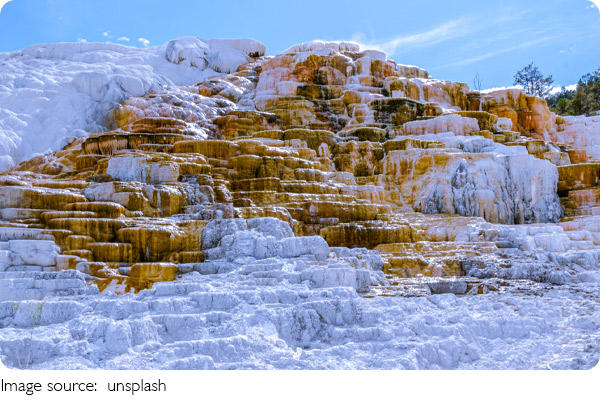
Hikespeak Pools of electric turquoise bleed into terraces of burnt caramel and chalky white, all sculpted not by human hands, but by superheated water rising through ancient limestone. The colors are not random. Yellow marks extremely hot water, while greens and blues typically indicate pools cooler than 140 degrees Fahrenheit — thermophiles, heat-loving microorganisms, are the true artists responsible for these vivid hues.
How These Terraces Come to Life
The Mammoth Hot Springs Terraces form when rain and snow seep underground, heat up near magma chambers, and dissolve limestone. As the superheated water rises back to the surface and cools, it deposits travertine — a type of limestone — that builds the terraces layer by layer. Every day, more than 4,000 pounds of dissolved calcium carbonate are carried into Mammoth by hot springs that emerge at roughly 170°F.
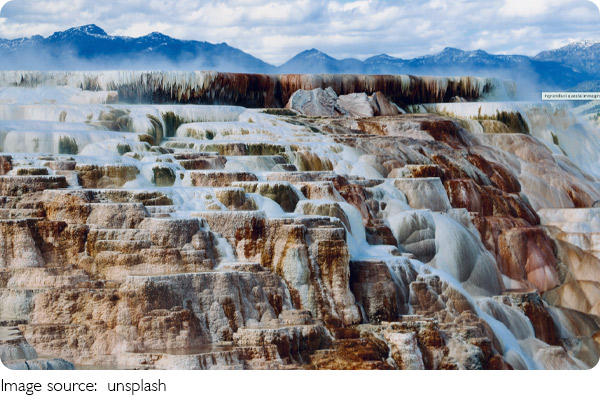
Wikipedia The result is one of the most dynamic geological spectacles on the planet — because of a travertine precipitation rate in very active zones of up to 5mm per day, the springs, pools, and terraces can look dramatically different after even a short time span. Volcanic-springs
Mammoth Hot Springs
Exploring the Terraces: Upper vs. Lower
Mammoth Hot Springs features two main areas — the Upper Terrace and the Lower Terrace — connected by boardwalks and staircases, with the Upper Terrace also accessible via a 2.3-mile driving loop.
Full Suitcase The Lower Terrace boardwalk covers 1.75 miles with 300 feet of elevation change, bringing you up close to famous features like the 37-foot Liberty Cap — a hot spring remnant named in 1871 by the Hayden Survey for its resemblance to the peaked caps of the French Revolution. Yellowstone Explored Plan for at least 2–3 hours to explore both sections properly.
The best times to visit are before 10 AM and after 5 PM when crowds are thinner, as the area has no shade and can become intensely hot on the boardwalks in summer. Full Suitcase
Practical Visitor Information
• Getting There: From the Roosevelt Arch at Yellowstone's north entrance near Gardiner, Montana, drive 5.7 miles south on Route 89 to reach the Mammoth Hot Springs parking area.
• Entrance Fees: A private non-commercial vehicle pass costs $35 and is valid for 7 days. US National Parks International visitors (non-U.S. residents) are now subject to an additional $100 surcharge per person aged 16 and older. Yellowstonewildtours An America the Beautiful Annual Pass at $80 covers all U.S. national parks for 12 months and is excellent value for multiple-park visitors.
• Hours: The terraces are accessible year-round. Mammoth is one of the few parts of Yellowstone with year-round access, making a winter visit a surprisingly atmospheric option. We're in the Rockies
• Staying Overnight: The historic Mammoth Hot Springs Hotel, nestled just below the travertine terraces, has welcomed guests since 1936 US Park Lodging and offers rooms from approximately $153 per night. Cabin options range from rustic shared-bathroom styles to private hot tub cabins available year-round. U.S. National Park Service
A Landscape That Rewards the Curious
Mammoth Hot Springs is not just a scenic stop — it is a living, breathing geological experiment happening in real time. No two visits are identical. A terrace that glowed turquoise on your last trip may be bone-dry and ghostly white the next. That impermanence is precisely what makes it so extraordinary. Come early, walk slowly, and let the Earth do the talking.