Dominate a Racetrack NOW!

Bianca
| 27-04-2026
 · Automobile team
Track-focused cars exist for one purpose: to turn physics into emotion.
Unlike everyday vehicles designed around comfort or efficiency, these machines are engineered to maximize grip, response, and driver engagement at high speed.
The following models represent some of the most capable and characterful cars currently built for track performance, each translating engineering philosophy into a distinct driving experience.
Caterham Seven 420R: Mechanical Purity at Its Extreme
Few cars embody minimalism like the Caterham Seven 420R. Descended from Colin Chapman’s original Lotus Seven concept of the late 1950s, it remains committed to the principle that reducing mass is the most effective way to increase speed. Weighing just over half a tonne, it uses a 2.0-litre naturally aspirated Ford Duratec engine producing around 210 horsepower, which delivers explosive acceleration simply because there is so little weight to move.
On a circuit, the Seven behaves like a direct extension of the driver’s inputs. There is no insulation between human and machine—steering feedback is immediate, braking forces are raw, and cornering balance depends entirely on precision rather than electronic assistance. Its sequential or manual gearbox reinforces the mechanical connection, rewarding smoothness and punishing hesitation. While it lacks comfort features entirely, that absence is precisely what makes it such a compelling track tool. Every lap becomes a lesson in momentum conservation and control.
Porsche 911 GT3: Engineering Discipline Refined Over Generations
The Porsche 911 GT3 represents a very different philosophy. Instead of stripping everything away, it refines complexity into balance. Developed alongside Porsche’s motorsport division, it uses a naturally aspirated 4.0-litre flat-six engine producing over 500 horsepower, capable of revving to a dramatic 9,000 rpm. This engine character alone makes it one of the most emotionally engaging modern performance cars.
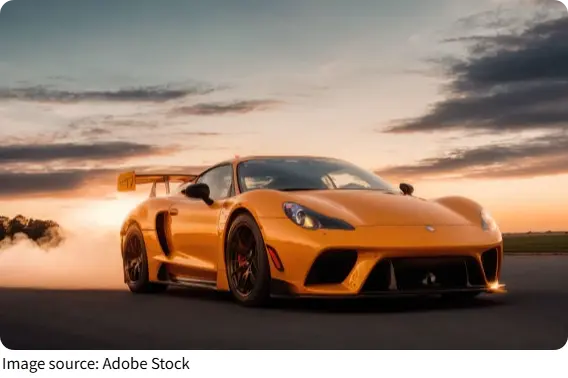
Unlike many high-performance machines, the GT3 retains remarkable versatility. Its rear-engine layout is carefully managed through advanced suspension geometry and aerodynamic stability systems, allowing exceptional grip under load without sacrificing predictability. The steering is renowned for its clarity, transmitting subtle changes in surface and load transfer with precision.
On track, it delivers consistency lap after lap. Braking stability is exceptional, and its chassis remains composed even under aggressive direction changes. Whether equipped with the manual gearbox or Porsche’s dual-clutch transmission, the GT3 is widely regarded by professional drivers and enthusiasts as one of the most complete road-legal track cars ever built.
Porsche 718 Cayman GT4 RS: Mid-Engine Precision Elevated
Where the 911 evolves tradition, the 718 Cayman GT4 RS takes a more radical approach. By placing the same 4.0-litre flat-six engine from the GT3 behind the driver, Porsche transforms the Cayman platform into a highly focused circuit machine. Producing roughly 493 horsepower, it benefits from near-perfect weight distribution, which gives it extraordinary agility in direction changes.
Aerodynamics play a critical role in its performance. A large fixed rear wing and carefully engineered airflow channels generate significant downforce at speed, increasing stability through fast corners. The suspension is firm and uncompromising, designed to maintain tire contact under extreme lateral loads rather than absorb road imperfections.
This is not a relaxed sports car—it is a precision instrument. Tire warm-up, brake temperature, and surface conditions all matter more than in softer road-focused vehicles. Once operating within its optimal range, however, it delivers cornering speeds and responsiveness that rival dedicated race machinery.
Ferrari 296 GTB: Hybrid Power with Surgical Speed
Ferrari’s 296 GTB marks a turning point in modern performance engineering. It pairs a twin-turbocharged V6 engine with an electric motor to produce a combined output exceeding 800 horsepower. This hybrid system is not designed for economy but for performance enhancement, filling torque gaps, and sharpening throttle response.
Its mid-engine architecture gives it natural balance, while advanced electronic controls allow drivers to tailor the car’s behavior through Ferrari’s Manettino system. Optional track-focused configurations enhance aerodynamics and reduce weight, increasing downforce and improving high-speed stability.
On a circuit, the 296 GTB feels remarkably agile for its power level. Acceleration is immediate, yet controlled, avoiding the abruptness often associated with turbocharged engines. The hybrid assistance ensures seamless power delivery out of corners, making it both brutally fast and surprisingly approachable at the limit.
McLaren Artura: Carbon-Fibre Intelligence in Motion
The McLaren Artura represents a more technical interpretation of track performance. Built around a carbon-fibre monocoque chassis, it combines a twin-turbo V6 engine with an electric motor to produce nearly 700 horsepower. Every component is designed with weight efficiency and structural rigidity in mind.
Its handling character is defined by precision. Steering response is immediate, and the chassis remains exceptionally stable during high-speed cornering. The hybrid system enhances torque delivery at low speeds while maintaining explosive acceleration at higher rev ranges.
Unlike more extreme track specials, the Artura retains usability on public roads, making it possible to drive to a circuit and immediately transition into performance driving. That dual nature reflects McLaren’s broader philosophy: reducing compromise without eliminating practicality entirely.
Each of these cars approaches the racetrack with a distinct philosophy. Yet despite their differences, they all share a common goal: to convert physical laws into driving excitement. And in that pursuit, each lap becomes more than a measurement of speed—it becomes a dialogue between machine, circuit, and driver that never truly ends.