Wanaka's Glacial Rivers
Darius
| 17-04-2026
 · Travel team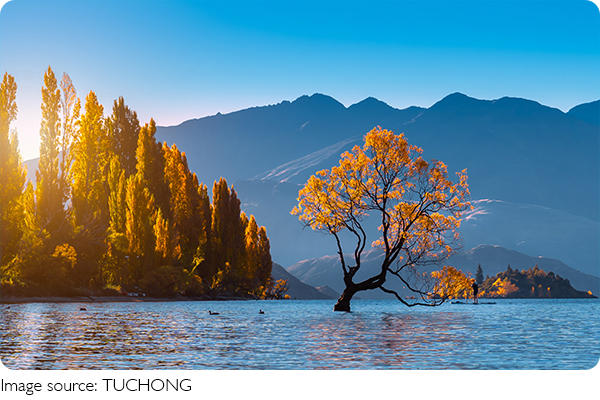
Have you ever seen a photograph so surreal it looked digitally generated? The image above is real.
That milky turquoise water threading between golden riverbanks and dark sediment islands is the Makarora River system near Wānaka, on New Zealand's South Island — and from the ground, it's even more breathtaking than any aerial shot can capture.
If this image has stopped your scrolling, here's everything you need to know to experience it in person.
Wānaka
What You're Actually Looking At
The photograph shows one of New Zealand's most distinctive and photographed natural features. The striking turquoise color comes from glacial flour: ultra-fine rock particles ground down by glaciers over thousands of years, suspended in the meltwater. This sediment scatters light in a way that produces that impossible blue-green tone no filter can replicate.
The multiple channels splitting and rejoining across wide gravel flats are characteristic of braided rivers, which form when fast-moving glacial water carries more sediment than a single channel can hold. The amber-colored vegetation on the banks is native tussock and riparian shrubs caught in their autumn transformation — one of the most photogenic seasons in the entire Otago region.
Getting to Wānaka
Wānaka sits on New Zealand's South Island, approximately four to five hours by road from Christchurch and about one hour from Queenstown.
Transportation options:
1. Fly into Queenstown International Airport (ZQN) — the nearest international gateway, roughly 60 kilometers from Wānaka; rental cars are available at the airport and are the most practical option
2. InterCity buses connect Wānaka to Queenstown, Cromwell, and other South Island destinations — tickets from approximately $15 to $25 per person one way
3. Rental car from Queenstown — the standard approach for most visitors; expect to pay $50 to $100 per day for a standard vehicle
4. Charter scenic flights to Wānaka's local airfield are available for those wanting an aerial arrival — and the views over the braided rivers on approach are unforgettable
A car is essential for accessing Treble Cone, Rob Roy Glacier, and Aspiring National Park — all of which bring you closest to the braided river landscapes shown in this photograph.
Best Time to Visit for This View
The golden tones visible in this photograph are characteristic of autumn in the Otago valley. Autumn colors in the valley are spectacular in April and May, when the surrounding tussock and native vegetation turn deep amber and rust. This is also the shoulder season, meaning fewer crowds and more affordable accommodation.
Summer (December through March) offers the warmest temperatures and clearest skies for photography, with long golden-hour windows ideal for drone work. Winter brings snow to the surrounding peaks, turning the landscape into a completely different kind of spectacle.

How to Experience the Rivers Up Close
Viewing the braided rivers from above requires either a drone, a helicopter flight, or altitude. From the ground, the experience is equally extraordinary — just different.
The Matukituki River is the best place for jet boating in the region, with options to skim over shallow braids, power through channels, and pause in deep glacial pools while guides share the natural history of the landscape. Wanaka River Journeys offers the most comprehensive experience, including:
1. Jet Boat and Wilderness Walk — a river journey followed by a guided walk through native forest, starting from approximately $119 per person
2. Glacier Jet — jet boat plus helicopter glacier landing, from approximately $375 per person
3. Scenic helicopter flights over the braided river systems and surrounding peaks, from approximately $150 to $250 for a 25-minute flight
Where to Stay
Wānaka offers accommodation across all budgets, from lakefront luxury to independent hostels.
- Budget: Wānaka Backpacker and similar hostel options offer dorm beds from $30 to $45 per night, with private rooms from $80 to $100.
- Mid-Range: Lake Wānaka hotels and self-contained apartments range from $150 to $250 per night, with lake or mountain views widely available at this price point.
- Luxury: Wānaka's sophisticated accommodation scene includes boutique lodges and high-end retreats from $350 to $600 per night, many positioned to maximize the mountain and lake views that make this region so remarkable.
Practical Tips for Photographers
1. Drone flights require Civil Aviation Authority registration in New Zealand — check current regulations before traveling
2. The best aerial light over the braided rivers falls in the two hours after sunrise and the hour before sunset
3. Autumn (April to May) delivers the warm tonal contrast between turquoise water and golden vegetation seen in this photograph
4. For ground-level river photography, rubber boots are essential — the gravel flats are accessible on foot but the channels are active
Standing at the edge of a braided glacial river in person — watching that impossible turquoise water split and merge across silver-grey gravel under a sky full of Southern Alps — is one of those moments that resets your sense of scale. The photograph above is stunning. The reality it represents is something else entirely. Have you ever been somewhere that looked more real in a photograph than in your memory? Wānaka tends to work the opposite way.