Shark Bay

Arjun Mehta
| 15-04-2026
 · Travel team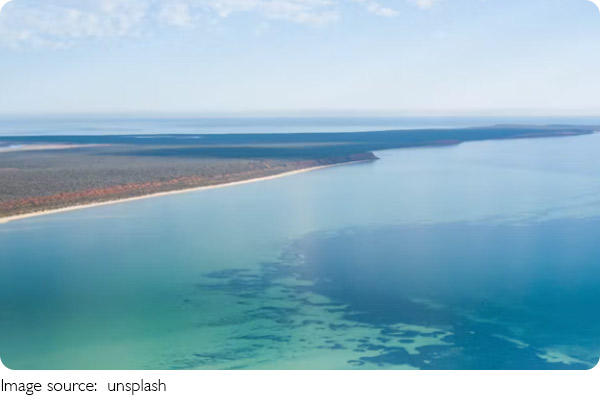
From above, it looks like a fevered painting — burnt orange earth bleeding into teal water, white salt flats slicing through like brushstrokes, blue threads weaving between rust-red headlands in illogical curves.
From the ground, it looks like the edge of the world, which in many ways it is.
Shark Bay sits on the westernmost point of the Australian continent, approximately 800 kilometers north of Perth, and it contains one of the most visually and ecologically extraordinary coastal environments on the planet.
UNESCO recognized Shark Bay as a World Heritage Site — one of only a handful of places in the world to meet all four of the natural criteria required for that designation. Have you heard of Shark Bay, or has Western Australia been sitting beyond the edge of your travel planning? Either way, here is everything you need to understand why this place is worth the distance.
Shark Bay
What Makes Shark Bay Extraordinary
Shark Bay earned its World Heritage designation across four distinct categories — an unusual achievement that reflects the breadth of what the region contains. The site protects one of the world's largest seagrass meadows, covering approximately 4,000 square kilometers and supporting a marine ecosystem of exceptional density and diversity.
It contains the world's most significant population of stromatolites — living structures built by microbial communities that represent some of the oldest life forms on Earth, dating back over 3.5 billion years in evolutionary terms.
The terrestrial landscape is equally remarkable. The peninsula systems that create the dramatic aerial color contrasts visible from above — the Peron Peninsula and the Edel Land Peninsula — are composed of red sandy soils and limestone formations that meet the Indian Ocean in configurations that produce the teal and orange color contrast that aerial photography has made recognizable worldwide.
The marine population includes over 10,000 dugongs — representing approximately 10 percent of the global population — along with dolphins, sharks, rays, sea turtles, and humpback whales during migration season. Monkey Mia, a specific beach within the Shark Bay region, has become internationally known for the wild bottlenose dolphins that come to shore daily to interact with visitors — a behavior that has been occurring consistently for over five decades.
Getting There
Shark Bay is located approximately 800 kilometers north of Perth on Western Australia's coast. The most practical way to reach it is by driving the North West Coastal Highway — a journey of approximately eight to nine hours from Perth, passing through the town of Geraldton and continuing north through increasingly remote landscape.
Car rental from Perth starts from approximately $60 to $90 per day for a standard vehicle. A four-wheel drive vehicle is recommended for accessing some of the more remote areas within the Shark Bay region, with 4WD rental starting from approximately $120 per day. The drive itself is part of the experience — the landscape transitions gradually from Perth's Mediterranean-climate surroundings into the red earth and coastal saltbush of the mid-west region.
Flights from Perth to Shark Bay Airport near Denham — the main town in the region — operate several times weekly with Regional Express Airlines, with tickets starting from approximately $180 to $280 each way depending on availability. The flight takes approximately one hour and thirty minutes.
From Shark Bay Airport, car rental is available through local operators from approximately $80 to $100 per day — essential for exploring a region where distances between attractions are measured in tens of kilometers.
Key Attractions and Practical Costs
Shark Bay falls within a national park and nature reserve system that charges entry fees for vehicle access to specific areas.
1. Monkey Mia Dolphin Reserve — the most visited single site in the region, where wild dolphins come to shore daily in the morning hours. Entry costs approximately $15 per person. The dolphin interaction typically occurs between 7:30 a.m. and 10 a.m., with arrival by 7 a.m. recommended to secure a position at the shoreline.
2. Hamelin Pool Stromatolites — a boardwalk providing close access to the living stromatolite formations in a sheltered bay. Entry is free and the site is open throughout daylight hours. The structures themselves are fragile and the boardwalk keeps visitors at a respectful distance.
3. Eagle Bluff — a raised headland lookout providing aerial-perspective views over the teal water and tidal flat formations that produce the color contrasts visible in drone photography of the region. Entry is free and the short walk to the viewing platform takes approximately 10 minutes.
4. Shell Beach — an 80-kilometer stretch of beach composed entirely of cockle shells rather than sand, in some places several meters deep. Entry is free and the beach is accessible directly from the main road.
Where to Stay
Denham, the main town in the Shark Bay region, provides the primary accommodation base for visitors. It is the westernmost town in Australia and has a permanent population of approximately 500 people.
Shark Bay Hotel offers the most comfortable accommodation in Denham with rooms from approximately $140 to $180 per night. The Heritage Resort Shark Bay provides self-contained apartment-style accommodation suitable for longer stays from approximately $120 to $160 per night.
For travelers seeking closer proximity to the dolphin experience, the Monkey Mia Dolphin Resort sits directly on the beach at the dolphin interaction site with rooms from approximately $180 to $250 per night — the only accommodation option that places guests within walking distance of the morning dolphin visits without requiring an early morning drive.
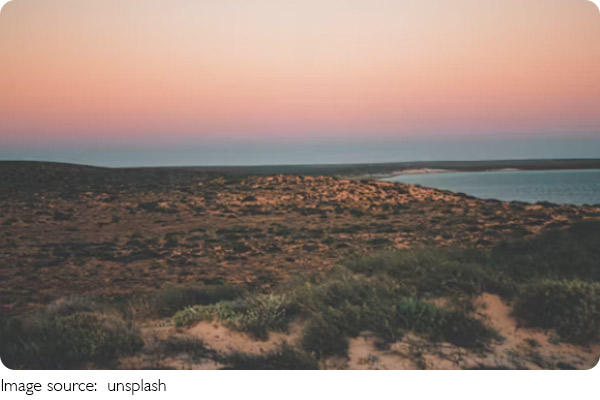
Shark Bay recalibrates your sense of scale — colors visible from the air come from forces operating across billions of years. Stromatolites in Hamelin Pool have built their structures for 3.5 billion years. Dolphins have returned to the same beach for decades, forming unplanned bonds with humans. Been there? Or is WA still on your list? Either way, the teal water and red earth will be waiting — and from above, they still look exactly like the painting.