Capturing the Perfect Sunset

Isla
| 06-03-2026
 · Travel team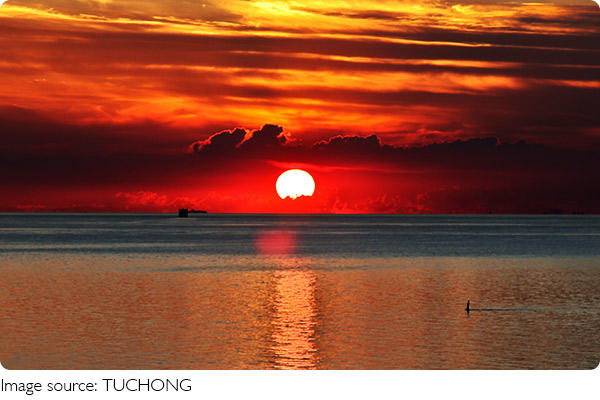
There's something universally mesmerizing about a sunset.
The way the sky shifts from golden hues to deep purples, reflected on water or silhouetted against landscapes, makes it a favorite subject for photographers.
Yet, capturing the fleeting beauty of a sunset isn't as simple as pointing your camera at the horizon. Timing, composition, and camera settings all play a role in transforming a momentary scene into a lasting image.
Timing is Everything
Golden hour awareness
Sunsets occur quickly, with the sky changing colors in just a few minutes. Arrive early—at least 30 minutes before the sun touches the horizon—to scout your location and frame your shot. The golden hour not only enhances warm tones but also softens shadows, making subjects more visually appealing.
Weather and clouds
Clouds can amplify the drama of a sunset by reflecting light in rich patterns. Check the forecast and aim for partly cloudy skies. Even thin layers of clouds can create striking gradients, while a clear sky might give a minimalist, serene effect.
Seasonal differences
The position and speed of the sun change with the seasons. Understanding seasonal variations helps plan shots, whether you want the sun to set over mountains, water, or urban skylines.
Composition Techniques
Rule of thirds
Place the horizon either one-third from the top or bottom of the frame instead of dead center. This balances the sky and foreground, creating a more dynamic and visually appealing composition.
Foreground elements
Including trees, rocks, water reflections, or silhouettes of people adds depth and scale. A lone tree or a gently rippling lake can transform a simple sunset into a storytelling image.
Leading lines and symmetry
Use paths, rivers, or shorelines as leading lines to draw the viewer's eye toward the sun. Symmetrical reflections on water or mirrored landscapes can enhance visual harmony, making your shot feel more immersive.
Camera Settings and Techniques
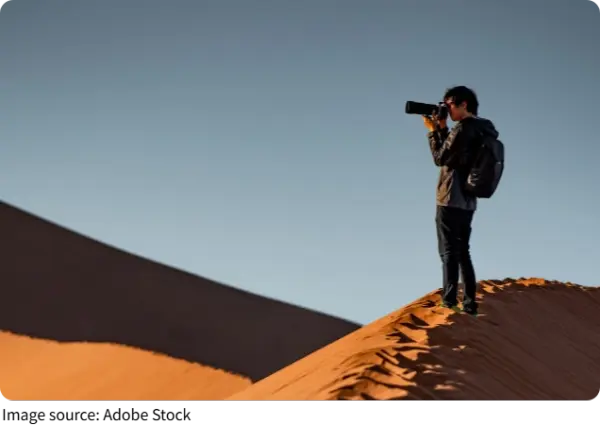
While timing and composition shape your image, camera settings determine how well you preserve color and detail.
1. Aperture
For landscape sunsets, use f/8 to f/11 to keep both foreground and background sharp.
If you want a dramatic sunstar effect while the sun is visible, try f/16.
For soft foreground blur or subject isolation, use f/2.8 to f/4.
2. ISO
Keep ISO low to maintain clean, vibrant colors.
ISO 100–200 is ideal.
If light drops quickly and you don’t have a tripod, you may raise it to ISO 400.
3. Shutter Speed
Adjust based on light intensity:
1/125–1/250 sec when the sun is still bright
1/30–1/60 sec just after sunset
1–5 seconds for smooth, silky water effects (use a tripod)
Slower shutter speeds create a dreamy atmosphere, especially with moving water.
4. Exposure Control
Sunsets create high contrast between bright skies and darker foregrounds. Slightly reduce exposure to protect highlights. Start with –0.3 to –1.0 EV to preserve rich colors and avoid washed-out skies.
For challenging lighting, use exposure bracketing:
3 shots: -1 / 0 / +1 EV
or 5 shots: -2 / -1 / 0 / +1 / +2 EV
This allows you to blend exposures later if needed.
5. White Balance
Set white balance to Cloudy (6000–6500K) for warmer tones.
For even richer warmth, try Shade (around 7000K).
Avoid Auto White Balance if you want consistent sunset colors.
6. Focal Length
16–35mm (wide angle) for expansive skies
35–70mm for balanced compositions
70–200mm (telephoto) to make the sun appear larger and more dramatic
Telephoto lenses compress perspective, intensifying the sunset’s impact.
7. Stability and Focus
Use a tripod when shutter speed drops below 1/60 sec.
Activate a 2-second timer or remote shutter to prevent camera shake.
Turn off lens stabilization when mounted on a tripod.
Focus about one-third into the scene or use hyperfocal distance to maintain overall sharpness. For silhouettes, focus on the edge of your subject for crisp outlines.
Capturing a sunset is about anticipation, observation, and subtle adjustments. Each one is unique, influenced by weather, location, and season. By planning ahead, composing thoughtfully, and fine-tuning your camera settings, you can preserve the fleeting magic of a sunset in photographs. Beyond technique, it's also a moment to pause, breathe, and appreciate the colors of the sky—a reminder that some of life's most beautiful experiences are ephemeral yet unforgettable.